

The Mobility Lab Sion-Valais enables field experiments for tomorrow's mobility
The Mobility Lab was created in November 2014 to respond to the growing complexity of the mobility sector by proposing the implementation of innovative projects in the field. It is based on the assumption that only collaboration between local authorities, academia and transport companies will enable us to anticipate and best respond to these developments. To find out more about this initiative, our Alp ICT team travelled to Sierre to meet Prof. Yann Bocchi, HES-SO Valais-Wallis' representative in the Mobility Lab, and Prof. Maria Sokhn, and test Sion's famous SmartShuttles (see below).
In concrete terms, the Mobility Lab is a platform for collaboration between its five founding partners, whose complementary typologies and skills are unique:
- Swiss Federal Institute of Technology Lausanne
- The Canton of Valais
- Swiss Post, through its subsidiary CarPostal Suisse SA
- University of Applied Sciences Western Switzerland Valais-Wallis
- The City of Sion
Other partners can be integrated into the Mobility Lab, either as part of projects or as part of the consortium itself.
The aim of this joint initiative is to generate new ideas and facilitate experimentation in the field by encouraging collaboration. In the words of Flavien Claivaz, Head of Passenger Marketing Valais and Western Region at PostBus: "Nothing can replace experience in the field". This practical implementation of projects enhances the knowledge and services of the industrial partners, and meets the growing needs of public authorities in the mobility sector. What's more, these field experiments also provide opportunities (research, training, start-ups) for the academic world. The partners involved are also helping to create new high-tech jobs in Switzerland.
Sion, Valais and Switzerland are world pioneers in the use of automated buses
A dozen projects are currently underway, each with its own funding.
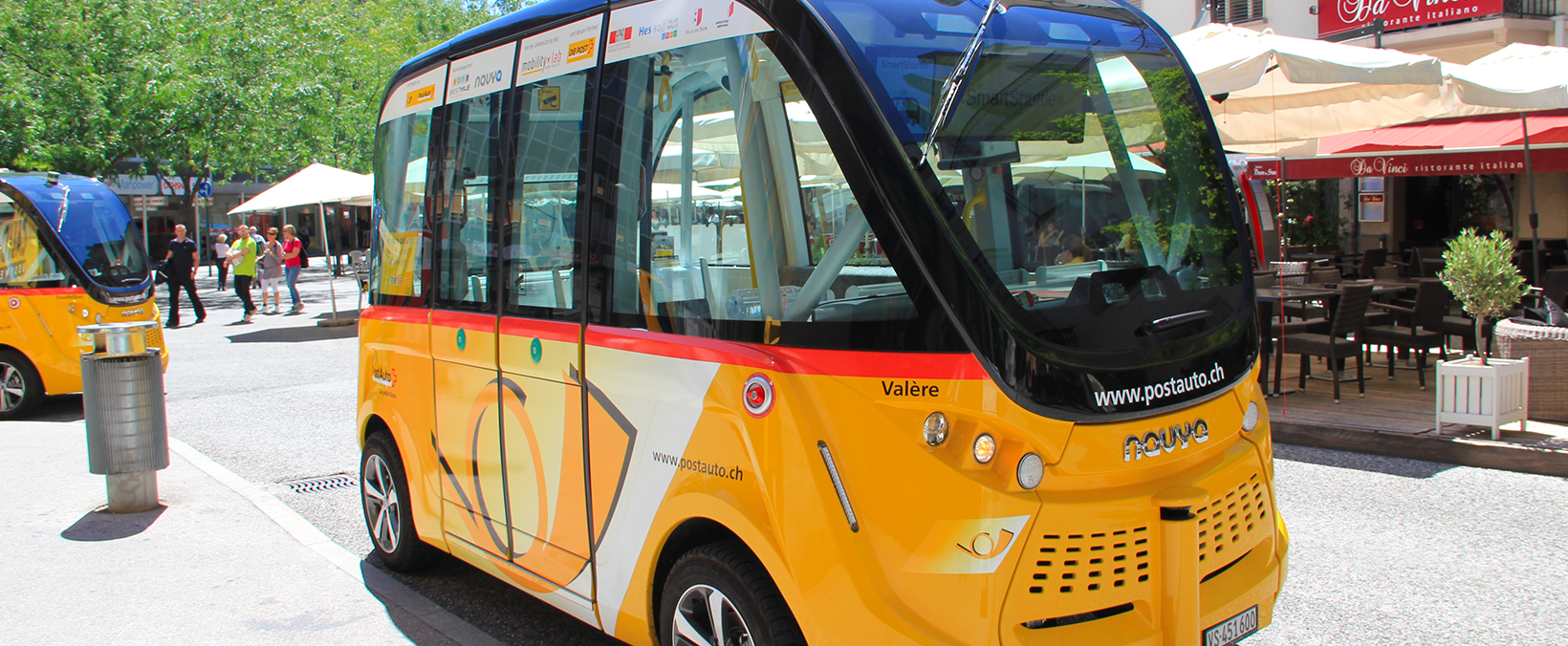
The flagship project is the "SmartShuttles" autonomous shuttles operated by CarPostal in Sion, which have become international stars for the media and the public. It's a CTI project in collaboration with EPFL and BestMile, developed in just one year, which is remarkable. The participation of the Canton of Valais and the City of Sion helped to speed up the project, remove obstacles and rapidly obtain authorizations and approvals.
The launch of autonomous shuttles on public roads at the end of June 2016 was a world first. They operate in areas not served by public transport, in order to meet the objective of offering a complementary service to the current network. The service is free for passengers. In their first year of operation, the automated buses carried over 25,000 people through downtown Sion, several thousand of whom came expressly from the rest of Switzerland and abroad. In addition, 25,000 passengers tested the SmartShuttles demonstration shuttles at some 20 events in Switzerland and elsewhere in Europe.
A press release published in June 2017 gives a positive assessment of the launch of this pioneering project, both in terms of users and technological lessons. An initial study, the results of which were presented on September 12, 2017 by PostBus and HES-SO Valais-Wallis, highlights the acceptance of automated driving in Switzerland. Both the manufacturer of the Navya vehicles and the supplier of the BestMile autonomous vehicle fleet management and optimization software (an EPFL spin-off), collect and manage valuable information that is continuously evaluated and made available to FEDRO. Thanks to this unique test and research platform, PostBus and the Swiss authorities are doing pioneering work in the development and operation of automated bus systems . Those responsible will soon decide whether the test operation in Sion will end on October 31, 2017, or whether it will be extended and expanded geographically.
In addition to on-street operation, PostBus and Swiss Post are now also carrying out tests on a closed site in Berne, focusing on the operation of new functions related to automated driving in the public transport sector. The installation and operation of automated buses is complex and requires close supervision. The idea would be to remove the compulsory attendant from the vehicle and move towards complete autonomy.
Finally, one of the biggest challenges still lies in communication between SmartShuttle and other road users, so that traffic flows can be optimized while maintaining harmonious organization. The Mobility Lab is already thinking about additional services (facial recognition, eye tracking, mobile application, sensors, interconnection), and the HES-SO Valais-Wallis is working on the shuttle's interaction with its environment to smooth its integration into the rest of the traffic flow.
"Mobility as a Service
The Mobility Lab has enabled the development of other pilot projects, all of which are examples of the growing role of digitalization in mobility services for local authorities.
- The NOSE (Nomadic Sensing Ecosystem) research project aims to make the most of the existing communications infrastructure by grafting sensors onto PostBus vehicles (3G and WiFi) to offer "Smart City" type services outside urban centers. This system enables real-time local data to be collected using mobile sensors (e.g. road conditions), combined with an application for the general public. The challenge is to use this data and combine it with data from other organizations to offer a better driving experience. NOSE is also looking for partners with usecases (user needs, services) and data to provide, such as Météo Suisse or the Cantonal Police.
- Between Sierre and Martigny, a group of testers were able to try out the CIBO ("Check-In Be-Out") electronic ticketing system that PostBus has developed with partners in Spain, Italy, Germany and Switzerland. User feedback was excellent, indicating a real need for an easy-to-use e-ticketing solution that is also advantageous for passengers.
- In collaboration with the HES-SO Valais-Wallis and the Canton of Valais, the Mobility Lab has collected around 50 ideas for developing "PubliRide" car-sharing on the i-Brain platform. Their potential is currently being assessed with a view to field testing.
- City-Eye, an online map project from HES-SO that will enable people with reduced mobility to plan their journeys. Data will be collected by La Poste letter carriers. The "we map" application collects information by point of interest.
Other projects under development include the collaboration between CSEM and EPFL for the intelligent management of electric vehicles, the Smart Alpine Region concept to be presented at CES 2018 in Las Vegas, and the "NorthWest Mobile" integrated mobility platform.
The real revolution in mobility is the complementarity of services and collaboration.
According to Yann Bocchi, the revolution in mobility is the complementarity of different services. Multi-modal transport must become flexible, i.e. mobility must be adaptable to meet the changing needs of users.
What's more, complex innovations at the interface between societal needs and technological possibilities are only successful if they form part of strategic partnerships. The Mobility Lab Sion-Valais is a perfect example of the success of a collaborative approach.
The projects developed by the platform help to position Switzerland as a place where innovative technologies can be developed and tested. These are tests from which the entire mobility sector can benefit, and which are essential for finding sustainable and efficient logistics and mobility solutions. The challenge is to find out which applications bring real added value to institutions and citizens, and how to harness the underlying technologies to build the Smart City of the future.