

#TechDemo x Yllyl
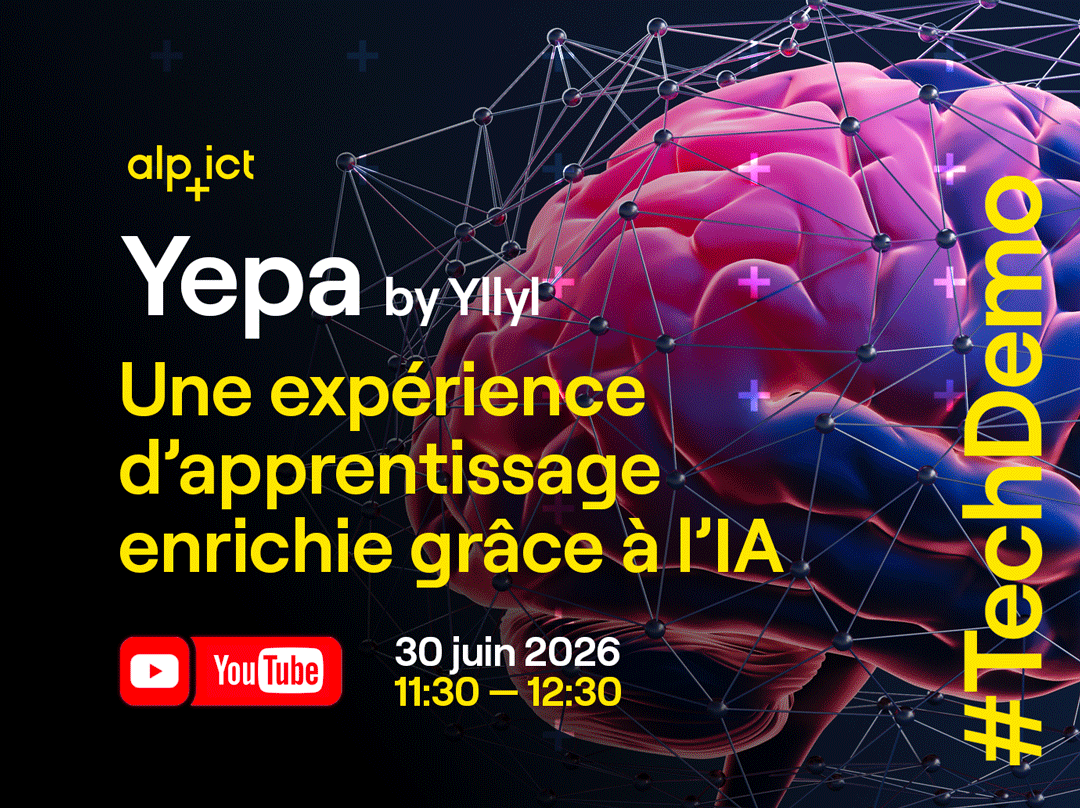
Join us on June 30, 2026, from 11:30 a.m. to 12:30 p.m., on the Alp ICT YouTube channel, with Joris Felder, founder of the startup Yllyl.
You learn as you live: digital pedagogy in the service of education.
Founded in the canton of Fribourg, Yllyl develops innovative solutions to help better understand, recognize, and develop the skills acquired throughout one’s life. At the heart of its approach lies the belief that skills are not limited to diplomas or formal training. Using a methodology for modeling learning experiences and digital tools powered by artificial intelligence, Yllyl helps individuals and organizations identify, analyze, and leverage the skills they actually use in their daily work.
Yepa: A smart platform for identifying skills and accelerating learning
With its Yepa solution, designed for professionals in training and coaching—and more broadly for small and medium-sized businesses—the startup Yllyl aims to highlight the often informal learning experiences that shape professional skills. The platform allows users to map out their learning environment, analyze their practices, and identify new opportunities for personal or professional development.
The promise:
- visual mapping of learning paths and experiences
- automatic identification of skills developed using artificial intelligence
- analysis of the resources, activities, and interactions that contribute to the acquisition of knowledge
- personalized recommendations for developing new skills
- recognition of skills gained through professional experience and informal learning
- support tools for HR managers, trainers, and coaches to assist with career transition, professional development, and talent management initiatives
Addressing the challenges of knowledge transfer and evolving skill sets in Swiss companies
For SMEs in French-speaking Switzerland, the ability to identify and develop skills is becoming a key competitive issue. The World Economic Forum’s *Future of Jobs 2025* report estimates that nearly 39% of the skills currently used in the workforce will need to evolve by 2030*. These needs are evolving rapidly as a result of digitalization and artificial intelligence. Companies must therefore be able to identify existing skills, detect untapped potential, and support their employees through a process of continuous learning.
Added to this reality is another major challenge: knowledge transfer. In many SMEs in French-speaking Switzerland, a significant portion of strategic knowledge relies on the experience of key employees. When this expertise is neither documented nor leveraged, it can become difficult to transfer during retirement, internal transfers, or periods of growth.
It is precisely to address these challenges that YllYl developed YEPA. By making the skills developed on a daily basis visible, the solution offers SMEs in Western Switzerland a new tool to manage their human capital, strengthen their resilience, and prepare for future transformations.
SOURCES
*Future of Jobs Report 2025, World Economic Forum, Jan. 2025
The monthly meeting place for SMEs to identify digital solutions
#TechDemo is the place to be for SMEs looking for digital solutions. Each month, we present a practical, innovative application to help you open up new opportunities, or simply make your day-to-day business easier. These events are free and require registration. They feature a 20-minute practical demonstration of the tool, followed by a 30-minute Q&A session.
Toward a measurable and organizational approach to AI.
"I'll save 5%, 10%, or 15% of an employee's time in support, sales, IT development, and so on, but we're still talking about individual productivity."
Yvan Cognasse, ORACLE
Yvan Cognasse, a member of the trio behind the Data & AI Observatory and Senior Director at Oracle, joined us in a recent episode of #TechTalk to discuss the issue of return on investment—a topic that has become central to any AI project—with the emergence of simple metrics for assessing the actual impact of deployments. This development marks a turning point: AI is shifting from individual use to a structural organizational lever.