


Take-aways FORWARD "Does the future of my business lie in the IoT?"
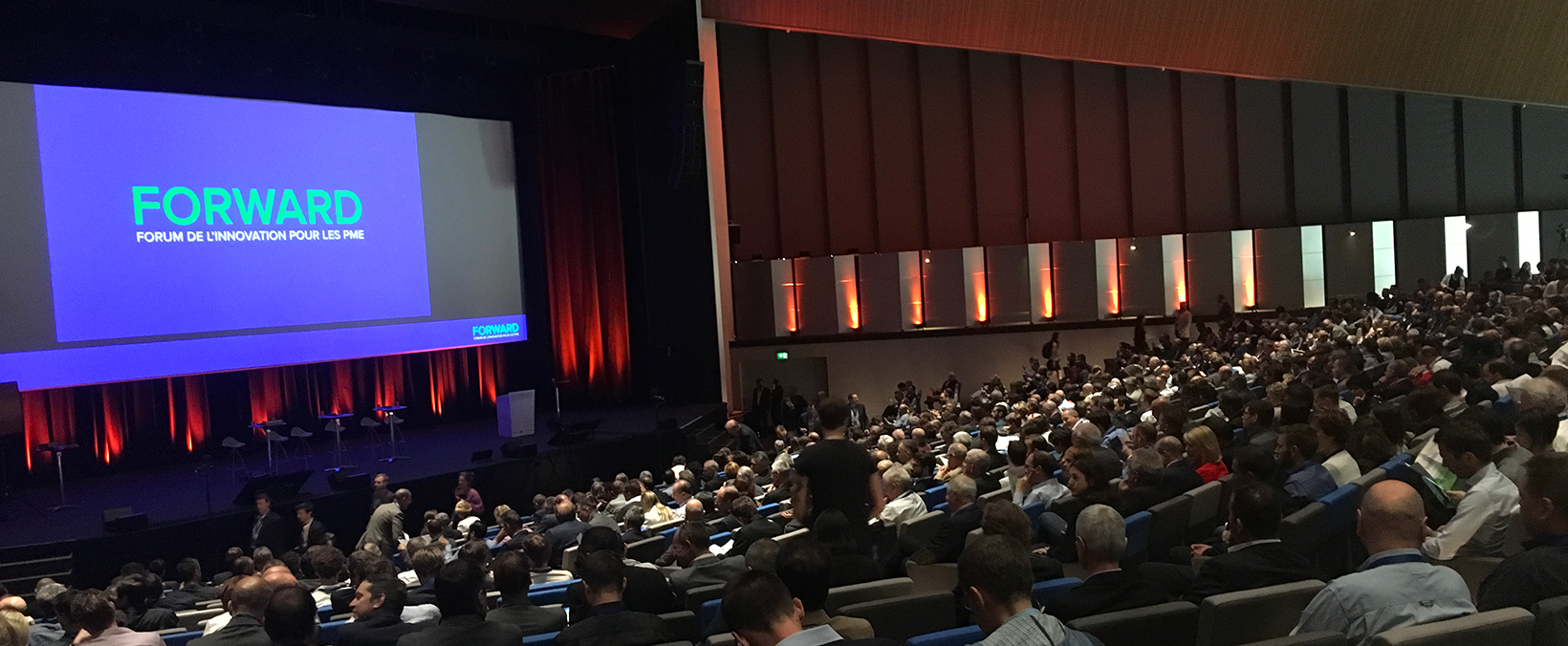
This was the question raised by the thematic workshop proposed by Alp ICT for FORWARD on April 19 at the SwissTech Convention Center. Organized by EPFL, Le Temps and PME Magazine, with the support of the State of Vaud, this new innovation forum aims to help business leaders identify and seize the opportunities offered by digitalization.
The first edition was a sell-out, with over 900 participants. A full day of conferences, entrepreneurs' testimonials, demonstrations and workshops. Among them, the workshop "Does the future of my company lie in IoT?" organized and moderated by Alp ICT.
The Internet of Things (IoT), like most digital tools, concerns all sectors of the economy and can benefit Swiss SMEs. These technologies impact not only products and services, but also business models, processes and, more generally, the way companies operate. It is essential that Swiss SMEs become aware of the importance of this phenomenon. That's what we've set out to demonstrate, by featuring three companies in French-speaking Switzerland who have successfully integrated IoT to reinvent themselves and/or invent new markets.
Smart parking benefits cities and users alike
Geneva-based family firm IEM has been manufacturing parking meters for thirty years(see our video interview here). "We've sold 30,000 of them in Europe. First they were mechanical, then electronic. The emergence of the Internet of Things has forced us, but also enabled us, to reinvent ourselves ", stresses Philippe Menoud, the company's General Manager.
The company is now using IoT technologies to harvest continuous, real-time data on parking, more specifically on parking usage by motorists, with a high level of detail. Users benefit from this information to find a space in real time, or even predictively thanks to machine learning.
"We can tell a city what the payment rate is for its spaces. We enable them to set dynamic rates, as tested in San Francisco. The next challenge will be to adapt to the arrival of autonomous cars," reveals Philippe Menoud.
In this way, IoT enables IEM to enrich its know-how and develop new parking management solutions, while retaining its customers: cities, cantons and municipalities. By transforming its business model, IEM is an example of a company that has taken full advantage of the digital revolution.
The smart supply chain to optimize logistics operations
In the logistics industry, Neuchâtel-based Kizy Tracking is reinventing the supply chain(read the interview here). By installing small, high-precision trackers on goods and equipment, Kizy provides first-hand data on their condition and location, in real time and anywhere in the world.
Supply chain companies can finally access complete transparency across the entire supply chain, offering numerous benefits, including: reducing costs, saving time, improving service quality, creating more trust with customers, and optimizing coordination between the various partners. "Our tracking solution is designed for Industry 4.0. It is reshaping entire industries: postal and courier markets, insurance, freight forwarding, textiles, the food industry, containers and shipping, the automotive industry and pharmaceuticals," explains Alexandre Luyet, co-founder and CMO of Kizy.
The smart prison or prison 4.0
"In 2010, we were called crazy. We started with a blank sheet of paper, for everything: the design, the sensor, the software", recalls José Demetrio, co-founder and CEO of Geosatis, an EPFL spin-off now based in Noirmont(read the portrait-interview here). In his view, the connected object leads us, not to a business, but to a new service. He encourages SMEs to explore areas parallel to their existing business, because that's where they'll discover new niches.
That's how the entrepreneur saw a need in prisoner support. In 2011, he created Geosatis, which offers a comprehensive electronic monitoring solution with connected bracelets, designed to target support and facilitate reintegration into civilian life.
The startup has rapidly evolved into an SME, accelerating its activities, expanding its market internationally and tripling its sales every year. They can now diversify by exploring new products. " We've created an ecosystem, then added products that create value," says José Demetrio. "The days when we went to Silicon Valley and looked the other way are over. In Switzerland, we're at the cutting edge in a number of areas, including connected objects. So let's move forward and dare to innovate!
Find out more about FORWARD :
- Full report on the day on the PME Magazine website
- Comment la numérisation aide les PME, article in Le Temps on the forum
- Family-run SMEs that have made the transition, article in Le Temps about the small businesses in French-speaking Switzerland on stage at the forum.