


Start-ups as innovation partners
Le Temps Blog article by Raphaël Rollier, trainer of the "Corporate-Startup: comment créer un partenariat important" workshop, of which Alp ICT is a partner.
Building bridges between large companies and start-ups is not always easy. However, it is becoming essential to ensure the company's capacity for innovation. For example, if you're an insurer looking to make the most of billions in medical data to help your customers stay in good health, you need to develop partnerships with start-ups specializing in artificial intelligence, because it's no longer possible to do everything in-house. So how can we make these bridges less slippery?
Innovation isn't just about having an original idea. Innovation is about achieving market success. In large organizations, one of the obstacles to implementing innovation lies in the corporate culture, which is generally better suited to improving existing products and cutting costs. Collaborating with start-ups is one way of increasing a company's capacity to innovate, but the ingredients for success are still very much a mystery.
On the other hand, a start-up needs to draw on the strengths of a large company, such as its know-how, access to customers and ability to deploy solutions on a large scale, to enable it to reach the growth phase.
With the aim of identifying these "ingredients" for a successful partnership with a start-up, last November the EPFL Innovation Park launched a new training course in the form of workshops. On the program: experience sharing, brainstorming sessions and collective resolution of each participant's challenges.
After two highly enriching series of workshops, here are a few interesting elements and examples that gradually lift the veil on some of the ingredients for success.
What are my motivations?
First and foremost, it's essential to clearly formulate the reasons why you want to work with start-ups, so as to focus your research, optimize your interactions and clarify your expectations. Two motivations strongly emerged from the discussions:
Develop a new market: interaction with start-ups enables business intelligence and entry into new markets. Samsung's innovation unit, for example, has set up partnerships and invested in start-ups to define its positioning in the transportation market.
Samsung has invested in AImotive, a company developing artificial intelligence for driving autonomous vehicles. It has also taken a stake in Valens, which offers connectivity solutions for vehicles. Thanks to AImotive's algorithms, we won't have to concentrate on the road any more, so we'll have to keep ourselves occupied in other ways, by watching our favorite films thanks to excellent connectivity in our car. Brick by brick, Samsung is developing its value proposition in the mobility of the future.
Evolve your corporate culture and acquire new skills: co-developing products with start-ups gives you access to new working methods and enables you to combine teams with different profiles. The "test and learn" approach, which is simply a matter of survival for a start-up, is thus applied in large companies, which are more accustomed to launching large-scale projects.
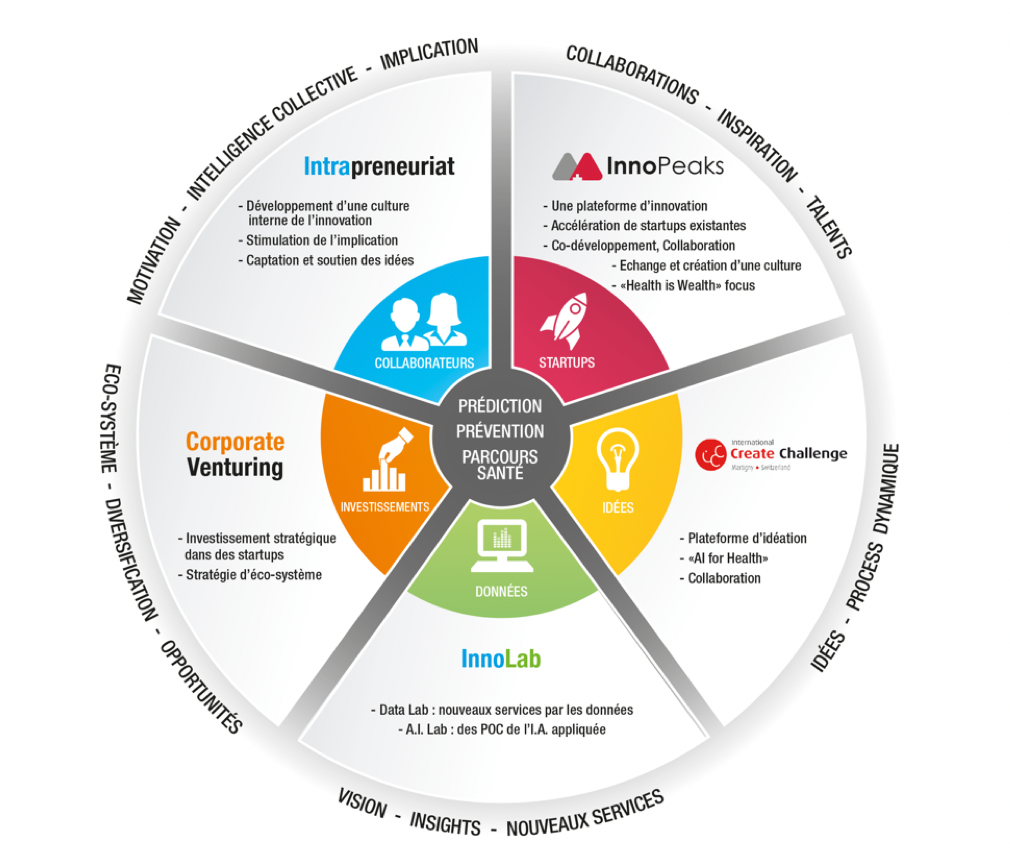
Various mechanisms exist to help identify startups with which to launch co-development projects; Groupe Mutuel, for example, set up its "innovation wheel" last year:
What forms of collaboration are needed?
Keeping customers healthy by putting (big) data innovation at the heart of its strategy: this is one of the main thrusts of the vision presented during the workshops by Nicolas Loeillot. To achieve this, two mechanisms have been put in place to acquire the necessary skills, provide the infrastructure and the right working environment:
Launch of a gas pedal: With the aim of attracting the best start-ups with artificial intelligence skills to add value to the medical information held by the insurer, Groupe Mutuel has launched a gas pedal called InnoPeaks. Each year, around ten start-ups spend 12 weeks on the insurer's premises.
Among the first batch is start-up Medicus. This company interprets medical reports and translates them into simple, understandable action for the patient. You install their app, take a photo of your blood tests and then discover what they mean, along with tips on how, for example, to reduce your glucose levels.
Creation of an Innolab: the wheel also includes the creation of a data innovation laboratory. The aim is to bring together all the information available within the group to develop algorithms and explore the many possibilities for adding value.
One of the first challenges is to help patients heal faster. By analyzing the health pathways of thousands of patients, the aim is to determine the most effective therapy and sequence of actions to take to heal the patient.
A collaborative approach to identify the ingredients of a successful partnership
Like Groupe Mutuel, many companies are launching initiatives to innovate through partnerships with start-ups. Geneva Airport, Coty, Total, Berney Associés and Maxon Motor took part in our first two training courses, all of them having set up some form of collaboration with start-ups.
On the other hand, entrepreneurs also attend these workshops to bring their own perspective. The pooling of these experiences and the confrontation of different points of view (the difference in perception between the entrepreneur and the innovation manager of a large group) will enable us to identify and share all those ingredients which increase the chances of success of a partnership.
If you would like to join this community, the next session will take place on September 5 and 6: https: //epfl-innovationpark.ch/collaboration-workshops/
Source : https://blogs.letemps.ch/raphael-rollier/2019/05/03/la-start-up-comme-partenaire-dinnovation/