


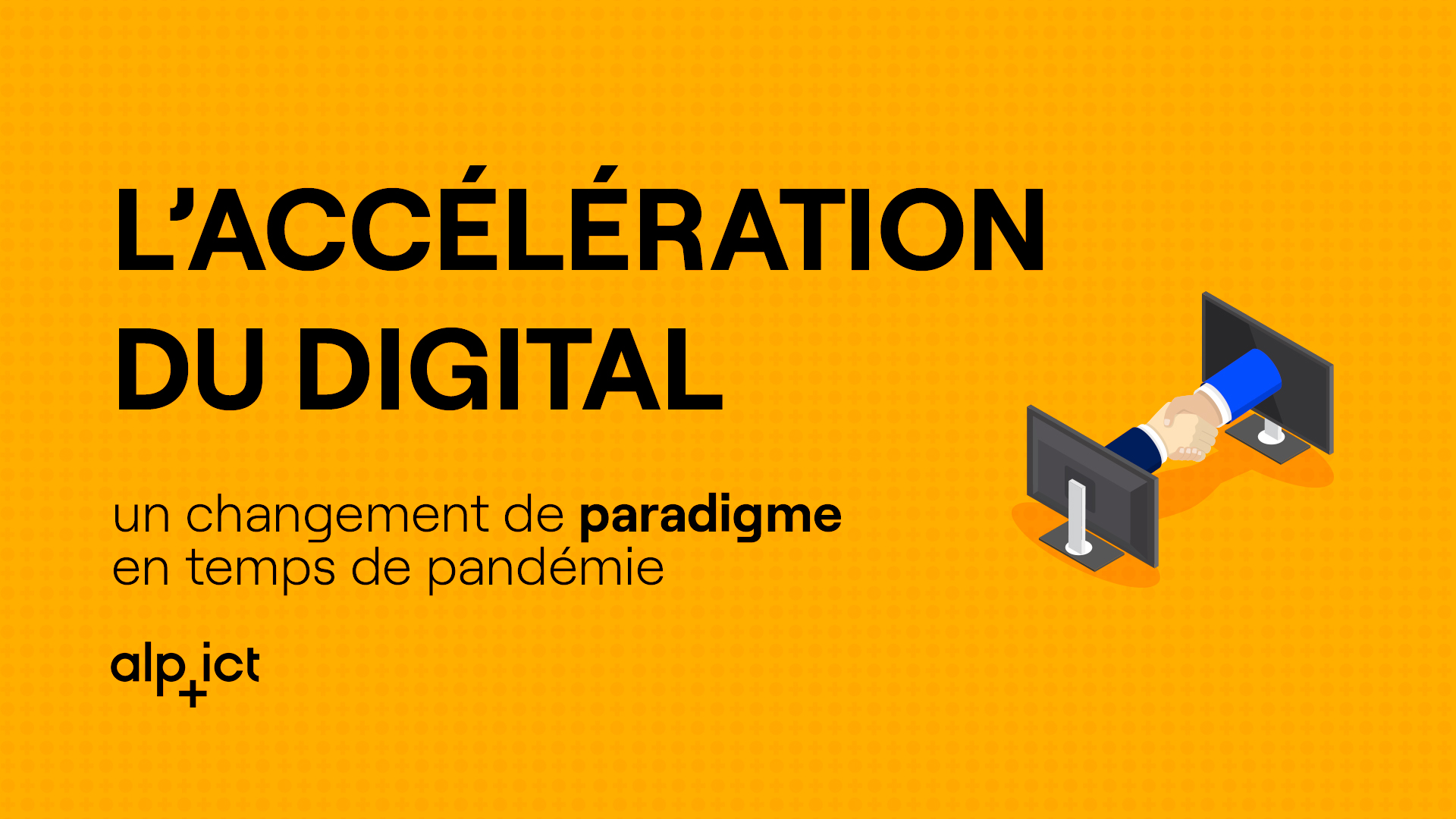
Coronavirus-proof digitalization
What's the point of digital?
This is often the question asked by the institutions and companies that are approached by digitalization service providers, and indeed, before the Coronavirus crisis invaded everyone's concerns, it was sometimes difficult to answer this question with solid arguments; "It's simpler", "It'll open up new markets for you" or "Everyone's doing it!". Mainly commercial justifications, with no real anticipation of what might happen.
However, in just a few weeks, more than half of humanity is confined. So it's a matter of business and economic survival that "everyone who can telework should". This injunction comes not from employers but from governments, who are rightly concerned about the economic consequences for our societies. However, they are less concerned about the extent to which companies will be able to produce remotely and collaboratively, while maintaining a certain degree of foresight for the months to come.
Accelerating digitalization
While employees' know-how is not affected by the relocation of production, it's the digital business and communication tools that are little or poorly understood by the majority of people forced to telework. For some, Skype, Zoom, Hangout and other communication tools are far less familiar than Instagram and Facebook. Even if this learning process is painful and urgent, there is no guarantee that companies that have neglected to integrate digitalization will not pay the price in the very short term. At the same time, companies that are sufficiently mature and had planned for the possibility of remote collaboration have suffered little or nothing from the shutdown. The return on investment here is not measured in monetary gain, but in the ability to maintain all or part of production during the crisis. Continuing training will certainly be a much more important issue after the crisis than before.
What's next?
Over the past few days, local and global digital players have announced that they are offering all or part of their services, from 30 days to 3 months free for all. Behind this sincere and altruistic approach lies an underlying revolution: some people's reticence towards digital, cloud and other collaborative platforms is set to give way to an over-exploitation of data-sharing services. Those who once resisted are now being forced to dive headlong into these new technologies, entrusting a large part of their sensitive data to those just waiting to make a profit.
Anticipating this approach would have been healthier, but what about the famous rules of confidentiality and data protection? All these concerns have now been relegated to 2nd place, and the urgency of the situation (and GAFA?) dictates the rules.
A new paradigm
In the coming months, it is highly likely that the dematerialization of design, sharing and collaboration processes will become increasingly important, and even indispensable, in order to ensure the continuity of several professions in the process of adopting digital technology. Architects and engineers with BIM, government departments with e-procurement, medicine with teleconsultation, and a host of other sectors will have to rethink their use of digital tools.
This acceleration can have dramatic consequences for some. While companies that had already planned teleworking as one of their digitization measures are hardly affected by this new situation, those that had put it off until the Greek calendar are now faced with the embarrassment of having to maintain production while implementing the digitization of their processes, which won't happen without breaking the bank.
What to do in the short term?
Despite all our current preoccupations, one thing is clear: we're all in the same situation, so how can we take the right steps quickly and deploy an effective short-term strategy?
The most sensitive issue is data hosting and sharing between employees of the same company. Indeed, if remote access to the company server is not planned, it is possible to store data temporarily or permanently in a cloud, more or less capable of offering associated services. Dropbox is the simplest solution, perhaps a little too simple for professional use. So Infomaniaka Swiss company, offers services identical to Google's, while guaranteeing data hosting in Switzerland. These services, for example, enable users to collaborate on spreadsheet (Excel) and page layout (Word) documents without the need for licenses or tedious installations, in a collaborative and inexpensive way.
Videoconferencing isalsobecomingan important application for collaboration or extended communication, with a wide range of tools offering much the same services: multi-participant conferencing, screen sharing, presentation projection, instant messaging, etc. Skype, Microsoft's flagship software, is widely used by the TV media in particular. It is preferred by its new little brother Teams, which is more oriented towards enterprise collaboration. Zoom is also currently taking a lot of market share, but beware of these products, which become chargeable after a certain time or for certain services. Infomaniak, again, launched their videoconferencing application, Meet, at the beginning of April, free and unrestricted for the time being.
The good news is that these new services are often less expensive than acquiring fixed solutions deployed on company servers. What's more, they don't require support from IT providers, and are designed for lambda users, who can configure all collaborative services quickly and easily. This is perhaps one of the positive aspects of this situation: we're naturally moving towards tools that are more agile, easier to deploy and less costly.
