

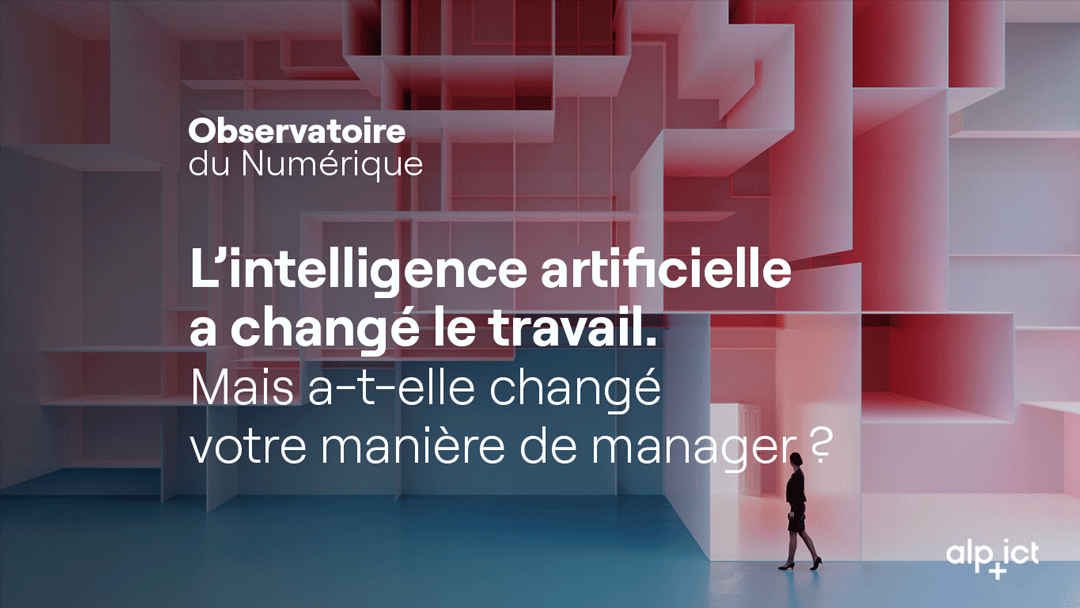
With artificial intelligence, the manager's role must adapt.
Artificial intelligence is becoming increasingly prevalent in businesses, but management practices are struggling to keep up. According to Laurent Balmelli, managers must now organize the environment in which teams and AI work: clarify knowledge, guide its use, and recognize those who contribute to it.
Insight: Written by Cédric Fischer, Partner at Agence Index, and Laurent Balmelli, General Manager for Citrix SecurSpaces
The tools are available, subscriptions have been paid for, and employees are already using artificial intelligence. Yet in many organizations, management remains unchanged. Meetings follow one after another, reports pile up on desks, and everyone carries on with their work according to established routines.
As if nothing had happened…
The disconnect is still somewhat surprising. If we are to take the transformations predicted by artificial intelligence seriously, we would likely need to draw some conclusions about how to manage an organization.
Dividing up tasks, establishing processes, and monitoring their execution: the manager’s role has long followed a well-oiled routine. Forty years of management literature have refined these steps to the point where they have come to resemble a tea ceremony. Every step has its place, every ritual its justification.
But the sudden emergence of artificial intelligence in the workplace is disrupting this gentle harmony.
Managers must now rethink how work is organized, because purchasing an artificial intelligence solution and waiting for the company to adapt to it is tantamount to entrusting technology with a decision that is not its responsibility.
Laurent Balmelli
The manager becomes the designer of the ecosystem
It must be said that the media’s coverage of artificial intelligence does little to help managers. By constantly comparing the performance of different models, we overlook a crucial question: Who designs and orchestrates the process—sometimes implicitly—in which employees will work? Who decides what information the system can access? And how does feedback from the teams enrich this shared knowledge?
Because what we need to create is a work environment where everyone can access information, consult artificial intelligence, and also contribute their own experience.
Laurent Balmelli
Most models have remarkable capabilities. However, they lack the internal context needed to understand your customer relationships, your pricing practices, or the rules that guide your decisions. To be useful to you, they must have a clearly defined role, defined limits, and controlled access to reliable documents. It is this context that transforms a generic engine into a tool tailored to your organization. To achieve this, agents—which rely on large language models—can leverage the data needed to perform the work. It is therefore essential to understand the tasks involved in managing these new virtual employees.
Understanding the System and Organizing Knowledge
This new approach to work doesn't require coding skills. But it does require an understanding of how tools, information, and workflows fit together, and then identifying where to intervene to make the whole system work.
However, in many small and medium-sized businesses, information is scattered among a few people and presented in ways that are sometimes contradictory. Making this information accessible to artificial intelligence through agents requires, first and foremost, clarifying it. How can we expect a reliable response from a system that is fed multiple versions of the truth? Some of the disappointments attributed to technology stem from this very source: poorly organized knowledge. The quality of the responses depends largely on the information made available. And this knowledge must be created, corrected, and shared.
Making knowledge sharing a recognized profession
That’s where the challenge begins. Much of an organization’s knowledge isn’t written down anywhere. It remains in people’s heads or is shared in passing—a customer’s objection, a solution found under pressure, the argument that sealed the deal during a negotiation. These experiences matter, but they rarely benefit anyone beyond those who lived through them. Once formalized and made accessible to the company’s artificial intelligence, they can be used by others, inform more relevant responses, and guide decision-making.
The expected contribution from employees is therefore expanding. It is no longer just a matter of completing a task, but also of documenting the lessons learned from their work and flagging information that has become inaccurate.
It is up to the manager to incorporate this activity into the actual work, devote time to it, and recognize its value.
Laurent Balmelli
It also involves a simple gesture: thanking those who contribute to our collective knowledge. A practice that may seem trivial at first glance but that nevertheless marks the emergence of a new corporate culture.
Reward those who share
However, this new responsibility is not without consequences. When an employee formalizes a specialized skill that set them apart, they transfer part of their value to the group. The company benefits: knowledge flows more freely, new hires progress more quickly, and the business becomes less dependent on a few individuals. But those who share may fear that they will become more easily replaceable.
Why give away what makes something valuable if you don't stand to gain anything yourself? A manager cannot avoid this tension.
Laurent Balmelli
Asking employees to contribute to the system requires specifying what they get in return: recognition, new responsibilities, learning opportunities, or career advancement. Without this incentive, knowledge sharing—the hallmark of this new AI culture—risks remaining nothing more than a pipe dream.
The real test, then, is not the number of licenses deployed. It is management’s ability to organize and recognize each person’s contribution to the knowledge that fuels the company’s intelligence. Ultimately, the differences among employees may have less to do with what they know than with their contribution to collective knowledge. But the organization must still give them the means to contribute and a reason to do so.
This cultural and technological shift opens up a new perspective for management: assessing an employee’s value based in part on what they enable others to accomplish. Shared knowledge could then play a full-fledged role in the recognition of work and in career paths.
Laurent Balmelli, who holds a Ph.D. from EPFL, co-founded two cybersecurity companies, which were acquired by Snapchat and Citrix. His career combines research at IBM, entrepreneurship, and innovation management—subjects he also teaches in Switzerland and Japan.